A Work Day in a Small Chinese Town on 2,000 RMB a Month
Video transcript
What does low income life actually look like when you leave China's mega city? In a place where the average monthly income might only be 2,000 to 3,000 RMB, around $300 how do people actually live, work, and spend their days? I think when people look at smaller town in China, they often imagine two extreme, either deep poverty or a stress-free, slow-paced paradise, but real life is usually somewhere in between. Today, I'm back in my hometown to show you that reality. I will take you deep inside the actual hidden workplace here to see what a small town
office day really looks like, but we will also dive into the rest of daily life from local housing and simple commute to what people actually do for fun at night when there are no fancy malls around. But also, you will see a lower income doesn't mean less joy. So, yeah, spend the day with me and let's look at the side of China that's rarely filmed. The first place I want to show you is the local village market here in my hometown. What is interesting is that it doesn't really look like a market in the way you might imagine in the city. Instead of
everything being in one organized building or area, it's more spread out along the street with people setting up right outside their own home. And this starts surprisingly early by around 6:00 a.m. Many of them are already here setting up their stalls for the day. You will see vegetable and small goods literally displayed at people's doorstep right in front of their houses. Most of the vendors here are older people, often selling vegetables they grow themselves in their own small plots of land. For many of them, this is just part of daily life rather
than a full-time job. In the morning, you will also see villager arriving on motorcycle coming here to buy fresh food for the day. It's a very simple, very local rhythm of life. One thing you will notice immediately is the price. Compared to the city, everything here is significantly cheaper. Some people set their goods on table, others directly on the ground, and you just walk through different small spots as you go along the street. There are also more traditional stalls here like this one selling chicken. You can actually choose live chickens and they
will prepare them on the spot, process them, clean them, and cut them into pieces for you to take home. Right next to the market area, there are usually small breakfast shops scattered along the street. In my hometown, some of the most common traditional breakfast are things like rice noodle rolls and noodle soups. I came to a rice noodle roll shop located right behind my grandma's house. This place has actually been running for over 30 years. The owner started here when she was in her 30s and now she's in her 60s and still working every day. The cooking
area is very simple and honestly a bit messy if you compare it to a city standard, but this is very normal here. Things are not always perfectly organized, but it doesn't mean the food quality is bad. It's just a different way of running a small local shop. I even tried speaking a bit of my broken Tay Cho dialect to order. I went for a rice noodle roll with two eggs and some meat. And guess how much that cost? Look at the portion. It only cost less than 1 US dollar. Honestly, it tastes really good. Do you have breakfast like this where you live?
Something simple, local, and something people just grow up eating every day. After finishing breakfast, I started looking at what kind of job people actually do in my hometown. Here, job opportunities are usually not posted online. Instead, you will often see them printed on paper and stuck on walls, electric poles, or shop fronts around the village. Most of these jobs are very basic factory or workshop roles. Things like sewing, garment production, and simple machine work. A lot of these positions are usually done by women, especially married women who
are looking for flexible, local work while staying close to home. But, the income here is actually quite different depending on the type of work you can do. The lower paying job are usually the very basic one like sewing or simple workshop task, and they usually pay around 280 to 420 US dollars. If you have more technical skill, the pay can be higher. Jobs like metal work, mold making, or other machine-related roles require more experience and hands-on skill. And this can go up around 560 to 700 US dollars per month. This is also an old man carrying
soil. This is a barber shop. This barber shop has been open for 50 years. You can see that is still an old man cutting hair for people. Next, I will take you inside what low-income woman's work actually looks like in my hometown. This is a small tailoring workshop. This is actually my aunt's workplace where she mainly does garment sewing. You can see that the space is quite messy with fabric pieces, part, and clothes spread all over the floor. This is my aunt's work station. She told me she works almost 12 hours a day starting from around 7:00 a.m. every
morning. And since it's summer, there's no air conditioning here, only a small fan. And everything is done inside this simple cement room. This woman here is one of my aunt's friends. She has been working here for about half a year. Right now, my aunt is showing me how the work is done step-by-step. First, she start by sewing the trouser hem using a sewing machine. Then, the front and the back parts of the trouser are stitches together. Next come the waistband. This elastic part is inserted and sewn into its place. After that, she checks the shape of the
whole pair of trouser to make sure everything is correct and there are no mistake. Then, the final step is finishing the waistband and completing the trouser. Once the whole process is done, the finished pieces are passes to another older woman who double-checks everything to make sure there are no defect. If everything is fine, this woman will add the drawstring into the waistband and then the trouser are officially completed. You can see pile of finished black trouser stack here. My aunt also show me a finished pieces. This is what the final product
looks like. Here you can really see that it's not just women in their 30s working here. There are also women in their 40s, 50s, and even older. Most of them work around 12 hours a day and some even skip lunch just to earn more. My aunt told me she can produce around 100 finished trouser in a day and each finished pieces pays about 1 RMB per trousers. That's roughly around 0.14 US dollars. That means in a month, the income is around 3,000 RMB which is about 420 US dollar per month. This is also the bathroom and basic facility here, but simple and quite
basic. When I asked my aunt if she needed help, she just told me it's better if I just watch her work. And after working for a long day, they regularly clean the sewing machine because of the dust built up. Most of them also wear masks because inhaling too much dust like that isn't good for the body. What really stood out to me is how repetitive and long this kind of work is, but it's also how many families here make a living every day quietly, without much attention from the outside. After showing the working condition, I wanted to take you to see where
people actually live in my hometown. This is an old ancestral house. It used to be where my grandparents lived, but now it has basically been abandoned. You can see moss growing on the ground and many of the room are completely empty and worn down. Inside, there are still some old belongings left behind, but overall, it feels like a place from a much earlier generation. This is probably the most traditional form of housing here, but nowadays, most people in the village live in a very different type of home. A few decades ago, my dad told me the land here
was very cheap. Many villagers could buy land for just a small amount of money and build their own houses. So, what you often see now are these red brick houses, simple self-built homes that represent most family in the village. For many people, building a house back in the hometown is not just about living space. It also represents status and achievement. After working in the cities and earning money, many people come back to build or renovate their houses. It is seen as a kind of success, a way of showing that they have made it in life. In a way, it's
also about face and family pride. And this one here is actually the most expensive houses in the village. It belongs to a friend of my dad. It has three floors and covers a total area of about 3,000 square meters. Locally, people even jokingly call it the White House of the village. My dad told me that the construction, furniture, and decoration together cost around 30 million RMB, roughly about 4.2 million US dollar. So, in the same village, you can see a huge contrast. Let me know if you want me to do a house tour here. I came back home because the
Dragon Boat Festival is coming soon as well, and my grandma was getting ready to make zongzi. The Dragon Boat Festival is one of the traditional festival in China. It falls on the fifth day of the fifth month of the Chinese lunar calendar. And the one of the most well-known is eating zongzi, sticky rice dumpling wrapped in leaves. We use soaked glutinous rice, pork, peanuts, mung beans, egg, mushroom, and these bamboo leaves to wrap everything together. The process is simple, but it actually takes a lot of patience. First, you prepare all the filling,
then fold the leaves into the space that can hold rice and ingredients inside. After that, you wrap it tightly with string so it doesn't fall apart when it's cooked. For me, it's not just food, it's also one of those family traditions that makes a hometown feel very different from my city life. Everyone prepare ingredients together, wrapping zongzi together, and keeping something from the older generation alive. I really wanted to help my grandma because I think this kind of traditional skill is very beautiful, but honestly, it looked way too difficult.
My grandma just told me to watch, so I stayed beside her and watched her and my mom wrap the zongzi together. And just looking at all of this, I already know they are going to taste so good. Next, let me show you how people get around here. In my hometown, it's a very different from the city. There are no share bikes everywhere, and probably buses are not something you can just easily rely on. So, most of people have their own motorcycle, bicycle, small trucks, or three-wheelers. You will also see these tiny electric cars that a lot of older people
drive. For people here, these are the most convenient ways to move around. Some people ride a few kilometers to the town center to buy food or daily things, and some people even use their motorcycle to go from shop to shop selling their own products. It's very simple, but this is how the daily life works here. People don't really depend on big transport system. They depend on their own small vehicle. This is where you can really feel the rural side of life. There are small farms, vegetable farms, rice farm, fruit tree, and also lychee tree around here.
Some of the vegetable people selling in the morning market might actually come from place like this. Grown up by family themselves, and then brought out to sell early in the morning. And this lychee tree are actually quite valuable here. They are not just part of scenery. For some family, they They also bring some extra income during the season. We ate the zongzi that my family wrapped earlier in the day for dinner. First, we filled the pressure cooker with water, then placed the zongzi inside and let them cook for about 15 to 20 minutes. Once you start
smelling the fragrance, you know they are almost ready. When we opened the pot, even the water had turned to the sweet zongzi broth. Some of the oil and flavor from the pork and rice had come out while cooking and it smelled so good. Then we opened the leaves and inside was the finished zongzi. There was my dinner that night. It's such a simple meal, but because my grandmom and my mom made it together, it felt very special. After dinner, I went out to see what people usually do in the evening here. In my hometown, evening life is much simpler. A lot of
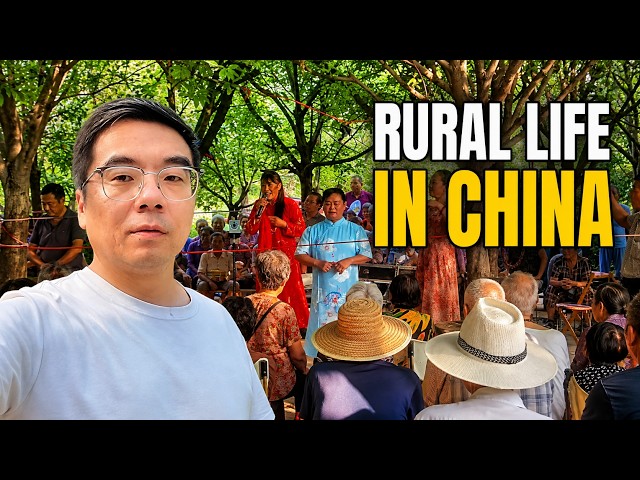
women and older people gather in the village square to dance together. This is called square dancing in China and it's very common in many towns and village. Nearby, some of the men and younger people play table tennis, chat with each other, or just spend time together after a long day. There aren't many fancy entertainment options here, but people still find their own ways to relax. So, this is what a low-income day in my hometown really looks like. It's not a perfect countryside dream and it's not just a sad story about poverty. Life here may be
simple, but it's not empty. I hope this video show you a more real side of rural China. Thank you so much for watching and I will see you in the next video.