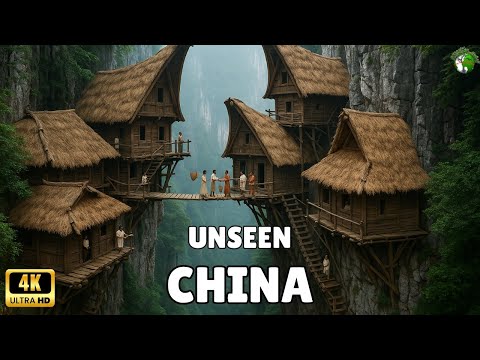
Unseen China: Hidden Villages, Deserts, and Canyons in 4K
Video transcript
If you think you've already seen the real China, these places will make you think again. Hidden beyond endless mountain ranges are ancient villages forgotten by time, lakes painted in extraordinary colors, breathtaking canyons, and landscapes that seem to belong only in legends. Some roads lead to places visited by only a handful of travelers where nature and history have remained untouched for hundreds, even thousands, of years. Each destination reveals a different side of China where the country's best-kept secrets become its most unforgettable
wonders. Welcome to Unseen China, a journey into the hidden places the world rarely gets to see. Seen from the outside, Fujian Tulou look like giant earthen fortresses built to hide an entire village inside. This is an ancient system of communal homes of the Hakka people in the mountains of Fujian, known for round or square >> >> enclosed buildings set among fields and hillsides. Some Tulou have thick earthen walls, several floors, and only a few narrow entrances, enough for an entire clan to live, defend itself, and keep community order through many
generations. Inside those thick walls is a wide open shared living space with a central courtyard, wooden corridors, hearths, ancestor altars, and rooms >> >> stacked in layers around it. When darkness falls over the black tile roofs and the ring of earthen walls closes around the inner courtyard, Fujian Tulou leaves a mysterious feeling about a part of China that once protected itself through the very shape of its homes. A blue moon rests in the middle of Dunhuang sea of golden sand, >> >> and Crescent Lake is the kind of oasis that makes the desert
look as if it is hiding a miracle. >> >> The lake has a natural crescent shape and lies just below the Mingsha Sand Dunes, where the wind can make the sand give off a deep ringing sound. Although it is surrounded by a hot dry desert, the water still remains beside the tall sandy slopes, creating a strong contrast between blue, gold, and the shadows of the hills. Along the edge of the lake are rows of reeds, green trees, and an old pavilion, making the scene look like a secret stop left behind on the Silk Road. Visitors often walk along the wooden path by
the lake, climb the sand dunes, or pass slow-moving camel caravans to look down at the curved water in the desert. When the wind pulls thin streaks of sand across the slopes, Crescent Lake leaves behind the image of a blue piece of moon lying still in the Gobi, like a secret of unseen China that has never run dry. If there is a valley in China that looks as if it was built between cliffs and legend, Wangxian Valley is that place. This is Wangxian Valley, a destination in Shangrao, Jiangxi, known for its old-style buildings that follow the shape of the
canyon terrain. >> This area was once connected with granite quarrying before the old cliffs were transformed into a tourist valley with architecture hanging along the rock face. By day, layered tile roofs appear close to the mountainside making it feel as if the whole village is being lifted off the ground. As visitors walk through the narrow stone paths, they can hear water echoing beneath their feet and feel the depth of the valley very close beside them. At night, Wangxian Valley leaves a stunning image of bright golden houses hanging on dark cliffs
like a secret of China that the world rarely gets to see. If nature had ever tried to paint mountains with every color at once, Zhangye Danxia is where that picture still lies untouched on the ground. Scientists say the red, yellow, orange, and gray bands here come from ancient sediment layers that were compressed, bent, and exposed after millions of years of tectonic activity. The mountain slopes do not rise as sharp, cold cliffs, but curve into soft ridges like waves stretching across the dry land of Gansu. After rain, moisture makes the mineral colors
deeper, making the hillsides look as if they have just been covered with a fresh coat of paint. Visitors follow elevated walkways to look down at the parallel bands of color, where each turn opens up a completely different section of mountain. As the last light of the day glides across the rock layers, Zhangye Danxia leaves behind the image of rainbow mountains lying still in the desert like a brilliant secret of China. The Yellow River does not fall into Hukou like a normal waterfall. It is squeezed tight, crushed, and thrown down into a rocky gorge
with a muddy roar. >> >> This is Hukou Waterfall, the largest waterfall on the Yellow River, located on the border between Shanxi and Shaanxi in northern China. The most powerful point of this place is where the wide river is forced into a narrow rock opening before plunging more than 100 feet like a massive water out of control. In front of viewers are layers of yellow-brown water swirling, crashing into black rocks, and spraying white mist across the canyon floor. Hukou leaves an overwhelming feeling of a part of China rarely seen where the Yellow
River becomes an ancient, fierce, and untamable force. Across the peaceful fields of Guangdong, Kaiping Diaolou rise like strange fortresses left behind in the countryside. These towers were built with several stories of stone, brick, or concrete with thick walls, narrow windows, and structures strong enough to resist robbery, floods, and unrest in the past. What makes them different is that domed roofs, balconies, decorative columns, and European-style facades stand on the foundation of traditional Chinese village architecture. >> >> Many towers were
built by overseas Chinese who returned to their hometowns, bringing with them money, memories of the West, and worries about protecting their families during a time of great change. Today, the Kaiping area still has more than 1,800 diaolou preserved to different degrees, including hundreds of well-kept structures that are open to visitors. If there is one place in China that looks like the surface of another planet, Heideshan is the land that makes viewers stop from the very first second. The black mountain slopes here were formed from layers of ancient
rock weathered in a harsh desert environment, leaving behind a rough surface like burnt coal. Around the foot of the mountains are white salt flats, yellow gravel, and open stretches of the Gobi reaching all the way to the horizon. The contrast between the black mountains and the light-colored ground makes Heideshan look like a giant ink painting placed in the Qinghai desert. As visitors walk across the loose gravel at the foot of the mountains, they hear almost nothing except the dry wind and feel as if they are wandering away from the familiar world.
Under the pale blue sky, the black mountain ranges lie still on the white ground like a cold secret of unseen China that never wanted to be awakened. There is a river in China that does not only flow across the land, but also carries the color of mud, the memories and the fears of thousands of years of history. It is the Yellow River or Huang He, the mother river of northern China and one of the most important waterways in the formation of Chinese civilization. More than 3,300 miles long, this river carries a huge amount of silt from the Loess Plateau,
turning the water its distinctive yellow-brown color like earth flowing downstream. >> >> In canyon sections and at waterfalls, the Huang He is no longer gentle, but rises into muddy masses of water, crashing against black rocks and throwing white mist into the air. Standing near the river's edge, visitors can hear the water roaring beneath their feet and watch the heavy silt-filled current rush through rock gaps like an ancient force that cannot be controlled. The Huang He leaves an overwhelming feeling of a land rarely seen, where beauty is not clear
blue, but fierce, muddy, and full of mystery, like Chinese history itself. Hidden at the foot of Zhongnan Mountain near Xi'an, Guanyin Temple appears like a small temple that time has tucked away behind ancient trees. What makes this place special is not a grand temple roof, but a ginkgo tree more than 1,400 years old standing in the courtyard like a living witness to the Tang Dynasty. >> >> Every late autumn, its canopy turns a brilliant gold, covering the temple courtyard like a bright carpet at the feet of the Buddha statue. In that quiet space, the
gray tiled roof, the old tree trunk, and the golden leaves create the feeling that all of Chinese autumn has gathered inside one small temple courtyard. Wanyin Temple makes China feel mysterious in a very quiet way, without needing high mountains or deep caves, only an ancient tree still dropping golden leaves after more than a thousand years. In the middle of a desert that seems to hold only sand and wind, Jade Lake suddenly appears like a jade green mirage that makes people stop and look for a long time. The strange color here comes from mineral-rich
salt lakes, where magnesium, lithium, potassium, and sunlight make the water change color with each depth. Instead of one single large lake, Jade Lake is a collection of many shallow salt ponds scattered across a white surface like broken pieces of blue-green glass in the Qaidam Basin. Around the lake, there are almost no large trees, only white salt shores, distant gray-brown mountains, and a high sky that makes the water look even more surreal. As visitors walk along the dry salt banks, they see small jade green pools right beside their feet, while the
white salt crunches under each step. In that harsh land, Jade Lake appears sparkling and lonely, a place where the most beautiful green emerges right in the heart of the desert. From above, the Badain Jaran Desert looks like a giant sea of sand pierced by blue lakes, making this Chinese desert seem both dry and unbelievable. This is a large desert in the Alxa region of Inner Mongolia, famous for its landscape of huge sand dunes mixed with rare inland lakes. >> >> The strongest feature of this place is its stable dunes, rising to about 1,509 ft, making
the desert look like an endless range of golden mountains. The lakes at the foot of the dunes create a strange paradox, where still water exists right inside land that seems unable to hold water. Badain Jaran Temple stands alone on the shore of a lake in the heart of the desert like a trace of Tibetan Buddhism left behind in a sea of sand. Badain Jaran ends with the sound of wind dragging across the sand where the whole desert seems to whisper a secret of unseen China among endless towers of sand. On a giant rock rising out from the mountains and forests
of Yunnan, Baoshan Stone Town looks like a village placed on the edge of a cliff. The ancient village of the Naxi people lies near the Jinsha River where the natural rocky terrain becomes the foundation for the whole settlement. Its most special feature is that the village has only about 100 households but three sides are protected by steep cliffs like a natural fortress. Around the village, small terraced fields have been opened on the slopes so residents can farm in conditions with little flat land. When walking along the narrow stone paths, visitors
can clearly feel that the entire village sits directly on a giant rock instead of flat ground. Baoshan Stone Town ends with the image of quiet Naxi rooftops clinging to the top of the rock with the Jinsha flowing far below in the valley. In the icy Ganjia grassland of Gansu province, >> >> Ganjia octagonal fortress lies silent like an ancient secret that time has never decoded. From afar, the brown earthen walls surrounding the residential area form an unusual shape, not square like many ancient Chinese fortresses, but opening into eight defensive
corners. In the past, this location once controlled an important route linking Gansu, Qinghai, and the Tibetan regions where many trade caravans, soldiers, and nomadic communities passed through. Inside that structure is a hollow cross-shaped layout, a rare design that makes this place look like both a military fortress and an ancient symbol set in the middle of the plateau. Today, low rooftops, narrow paths, and old earthen walls still remain inside the fortress, creating the feeling that present-day life is living side by side >> >> with a site more
than a thousand years old. >> >> The Maijishan Grottoes appear like a steep mountain mass carved into hundreds of small openings in the rock face. The Buddhist caves are cut directly into the mountainside, linked by wooden bridges, narrow steps, and paths that cling closely to the cliff. As visitors walk across the suspended walkways, they can see the valley opening wide below, while the cave-filled cliff lies close beside their shoulders. Inside the worship niches, statues of Buddhas and Bodhisattvas appear with slender faces, calm seated poses, soft
robe folds, and ancient layers of color still clinging to the stone bodies. At the top of Laojun Mountain, golden temple roofs sit in a sea of clouds like a Taoist palace lifted off the ground. >> >> The road up the mountain takes visitors through forests, cliffs, and rising stone steps before opening into a bright world on the summit. The most stunning site is the golden summit temple complex, where golden roof tiles reflect the light against white clouds and gray mountains. When the wind blows across the stone railings, small flags flutter in the open
air, while below, the valley is swallowed by clouds. In winter, snow clings to the temple roofs and tree branches, turning the whole mountain top into a cold, bright, and almost unreal Laojun Mountain does not need much movement. >> >> Just one person walking slowly on the stone steps among the clouds is enough to create the feeling of entering a land hidden in the sky. Could there really be a giant eye in the Qinghai desert looking up at the sky? >> >> Yes, it is Aiken Spring, a site that makes it hard to believe this is only a natural spring. >> >>
Sulfur-rich, mineral-rich water keeps rising from deep underground leaving wide reddish-brown rings of sediment around the mouth of the spring. Around it >> >> are the cold, dry Gobi, open bare ground, white streaks of salt, and distant mountain ranges >> >> lying faintly beneath the high sky. From up close, the spring bubbles at the center >> >> while the outer ground spreads out in many colored rings like the eyelids of a giant creature. >> >> Visitors often stand on the edge of the dry ground to watch from a distance drawn in by the strange colors
while keeping away from the strong mineral water and the soft ground. >> >> In that barren space, Aken Spring leaves the image of an unblinking eye of unseen China quietly looking up at the Gobi sky through thousands of years. Shaxi Ancient Town does not feel like an old town rebuilt for tourism, but like a real trading stop that still remains on the Tea Horse Road. This is an old market town in Jianchuan, Yunnan, once welcoming caravans carrying tea, salt, and goods through the mountains of southwestern China. The most special thing about Shaxi is that
its old market area is still considered one of the most intact remaining examples of a trading center on the Tea Horse Road. When walking across Siding Square, visitors can feel that this place was once a resting stop for merchants and pack horses for many centuries. Shaxi ends with the image of an old wooden stage standing still in the middle of the square >> >> like a piece of ancient China still waiting for footsteps to return. >> >> If deserts usually mean dry land, the Tengger Desert Lakes break that idea with hundreds of lakes scattered across the
sea of sand in Inner Mongolia. This is a desert lake system in the Tengger area of the Alxa Desert UNESCO Global Geopark, one of the strangest dry landscapes in northern China. The most striking feature is that this area has more than 400 desert lakes creating a rare maze of blue water in a sandy region of about 16,500 square miles. The lake surfaces nestled among the dunes create a strong contrast where the blue of the water appears right in the middle of golden sand slopes. Here, visitors can experience riding camels across the golden sand and sliding
down steep dunes where every rush downward makes this desert feel both wild and unforgettable. In a sea of clouds of Guizhou province, Fanjing Shan rises like a forgotten stone island in the sky of China. This is one of those hidden places that makes viewers realize that unseen China is not in the big cities, but hidden among damp mountain ranges, deep forests, and steep cliffs. >> >> The highest peak in the area rises to about 8,432 ft, creating many different climate layers from dark green broadleaf forest below to cold moss-covered slopes high above.
The most famous image is two small temples sitting on top of a split rock formation connected by a narrow bridge between the deep ravine and white clouds. To reach it, visitors must follow stone steps clinging to the cliffside where each stretch of the climb opens a different view down to the old forest below. >> When clouds flow across the bridge between the two temple roofs, the whole mountain looks like a fragile doorway into a part of China that the world rarely gets to see. Neither sea nor mountain, Yuanyang is a place where water and land together
draw an endless terraced ocean across Yunnan. In winter, the flooded fields reflect low clouds and cool light, making the whole mountain area look as if it were covered with thousands of silver mirror pieces. When spring arrives, the Hani people begin going down into the fields, guiding water through ancient channels, and preparing each narrow earthen ridge for the new planting season. Summer covers the entire terraced fields in a deep green, where layer after layer of young rice hugs the mountainsides like soft waves. By autumn, the fields turn golden,
transforming this farming system more than 1,300 years old into a living map of labor, water, and forested mountains. Dushanzi Grand Canyon opens like a giant cut along the edge of the Tian Shan mountains, making the land of Xinjiang look as if it has been torn deep downward. This canyon was formed by snowmelt water from the Tian Shan mountains wearing away the soil and rock over a very long time. The rarest feature of this place is its system of nine-layered river terraces recording traces of ancient streams that once changed elevation. >> >> On both
sides of the canyon walls, deep vertical grooves stand out clearly, creating the feeling that the entire mountainside has been carved by water into long lines. When standing close to the edge of the cliff, visitors can look straight down into the canyon floor and feel the open space right beneath their feet. >> The Shaanxi Grand Canyon ends with the image of gray layers of earth lying still in the wind like an ancient page of geology >> >> opened up in the middle of Xinjiang. Qikou Ancient Town does not sit still like a tourist old town, but feels like
an old river port still clinging to the earthen cliffs beside the Yellow River. This is an ancient town in Linxian, Shanxi, once an important transfer point between riverboats and overland transport caravans. During the Qing Dynasty, Qikou once had more than 380 shops and warehouses turning the streets by the river into a busy commercial center. Walking along the stone roads that follow the slope, visitors can imagine the sounds of wheels, camel hooves, and boats docking that once echoed here. The old stone steps lead down to the Yellow River, like a
path into the past still open beside the earth-colored water. Larung Gar spreads across the Sichuan Plateau like a giant red valley, where thousands of wooden houses cling tightly to the cold mountainsides. >> >> From above, the red roofs are packed so closely that the whole valley looks like a maze of spiritual practice set among clouds and mountains. Narrow roads weave between rows of wooden houses, where monks and nuns walk slowly over dirt slopes, stone steps, and paths covered with plateau dust. In that space, the wind slips through prayer flags, >>
>> thin kitchen smoke drifts upward, and prayer wheels turn gently under the hands of people passing by. When mist or snow comes down, >> >> the red color of Larung Gar grows deeper, as if the whole valley is sinking into a rhythm of life far removed from the modern world. >> Larung Gar leaves behind an image of a rarely seen China where faith is not held inside a single temple but covers an entire valley on the plateau. If there is one place in China where a boat looks as if it is flying through the air, Pingshan Grand Canyon is that unbelievable
illusion. This is a canyon in Hefeng, Hubei, often called China's Semporna because of its rare, clear, blue water. >> >> The most special thing about this place is that the riverbed can be seen clearly beneath the boat, making the water surface almost disappear before your eyes. Two tall cliff walls press close to the river, forming a narrow strip of sky above visitors' heads. Sitting in a wooden boat, you feel as if you are gliding over a sheet of blue glass deep inside the mountains. Pingshan Grand Canyon ends with the image of a small boat quietly
entering the shadow of the canyon where the peaceful beauty still feels overwhelming. Among the karst valleys of Guizhou, Anlong Pyramid appears like a cluster of stone pyramids resting quietly among villages and green fields. These hills are not man-made structures, but the result of carbonate rock worn down by rainwater and time over millions of years. Horizontal rock layers run around the mountain slopes forming even lines that make the massive look as if it was stacked in steps. The landscape here feels strange because ordinary rural life exists
right next to a geological shape that looks so much like an ancient structure. At the foot of these natural pyramids, are village roads, white rooftops, and small fields lying close beside the rock walls. >> At the far north of Xinjiang, Kanas Lake looks like a color-changing lake where the surface can shift from turquoise to deep blue in just one day. This is a glacial lake in the Altai Mountains near the remote border area between China, Kazakhstan, Russia, and Mongolia. Kanas' strongest feature is its maximum depth of about 618 ft, which makes the
calm water above feel even more mysterious below. The lake stretches for about 15 and 1/2 miles through the mountain valley, forming a curved band of water between the cold forests of northern Xinjiang. >> >> Walking along the lake shore, visitors can clearly feel the coldness of the deep water and the heavy silence of a mountain region almost separated from the modern world. Kanas Lake appears like a blue-green doorway to unseen China, so beautiful that it makes people stop for a long time and wonder whether beneath that water there is a secret hidden
that no one has ever touched. Under a giant rock roof in place of the sky, Zhongdong Cave Village exists like a village hidden deep inside the mountains of Guizhou. This is a Miao village inside a natural cave, where homes, livestock, and pathways all sit beneath a dark, cold cave arch. What makes this place hard to believe is that many families once lived in the cave year-round, separated from the main road by long mountain slopes and distant walking paths. The space inside appears with low wooden houses, rough stone floors, and a deep black cave
ceiling hanging overhead like a second sky. When stepping into the cave entrance, visitors can hear footsteps echoing on the stone, the sounds of animals carrying back, and a cold, damp feeling surrounding every breath. At the border between the light outside the valley and the darkness inside the cave, Zhongdong leaves a mysterious feeling of a part of China rarely seen by the world. Hidden at the foot of Meili Snow Mountain, Yubeng Village appears like a village held back by the snow mountains, where small rooftops sit among deep forests, cold valleys,
and trails almost cut off from modern China. This is a highland village in northern Yunnan, set within Tibetan cultural space and surrounded by sacred mountain ranges. What makes Yubeng special is its isolation, because the journey into the village is still tied to long mountain roads, thin air, and weather that changes very quickly. The grandest scene here is the contrast between the low rooftops in the valley and the snow peaks rising high behind them like a giant white wall. >> >> While walking along the trail, visitors can feel each step grow
heavier, hear the wind passing through prayer flags, and see the snow appear very close on the mountain side. Aoxiang National Forest Park is not like an ordinary forest, because each season here reveals a different face of the volcanic land of Inner Mongolia. >> >> This is a forest park located in the greater Khingan Range, famous for crater lakes, hot springs, and forests growing on ancient lava ground. In spring, azaleas bloom around the cold lakes, making the mountains once shaped by fire soften >> >> in bright floral colors. Summer turns Arxan into
a rare refuge from the heat, where green forests cover the mountain slopes and the lake surfaces hold a cool color in northern China. >> >> By winter, snow covers the black lava rocks, letting Arxan appear like a part of unseen China, where ancient fire and white ice lie still together beneath the deep forest.