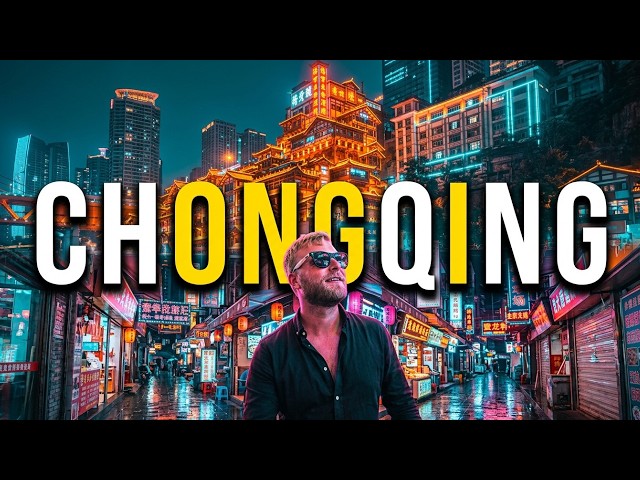
Chongqing: Inside China’s Real-Life Cyberpunk Megacity
Video transcript
Chongqing, a megacity of 32 million built on foggy mountains and steep cliffs. A cyberpunk city where trains go through buildings and your GPS is useless. Chongqing is so surreal it went viral and some people even thought it was AI generated. We spent a whole month here because we wanted to see if there is more behind the viral clips. And what we found was a side of Chongqing that no one else shows you. Ancient carvings, jaw-dropping nature and a secret military megaproject used to build and hide China's nuclear weapons. Chongqing is one of the only four
cities that are directly administered by the central government. It covers an area roughly the size of the entire country of Austria. The city center is at the intersection of the JiaLing and Yangtze river. And that's where things get truly wild. As you can see we're on the square, a bunch of buildings. You would think... ...We're on the ground floor. But which floor are we on? It's the 22nd floor. The barbershop there. And there's a bridge that connects those two buildings. And this is you were saying it's the roof of a hospital?! Yeah it's a hospital
underneath and now we're on top of it. Yeah but... It's also a square This is the ground floor. And in Chongqing that's pretty normal. You might get into a building, take the elevator to the 10th floor, cross to another building through a bridge, take the elevator again to the 15th floor and you're out on the street again. Multiply that by hundreds of buildings and you get a true 3D maze. So how do millions of people move around in a city like that? The answer is one of the craziest transportation systems we've seen. The monorail system here in Chongqing
is the longest in the world. It's 98 kilometers and can carry up to 32,000 passengers per hour in each direction. And we had to go through two underground passengers to get to this point. The city is very confusing. You need 3D maps and it's a constant up and down. What I love is look how green. It's a subtropical climate. So you have this insane contrast between a literal concrete jungle and a lot of greenery. Example of the complexity of Chongqing transportation system. So you have a road there, another road there, overpass here, this bridge and then
the monorail goes under this bridge. We just got out from the Liziba Tramway station. And guess what's so special about here? The train goes through a building! And look how many people here... insane. Everyone trying to sell you photos with the station, souvenirs, umbrellas because it's raining and everyone's standing here under the rain. It's very crowded, very stressful. And to get out of the station you have to go through a souvenir shop. So they're obviously capitalizing on how famous this is. On top of trains they go through buildings or under
bridges in Chongqing. You can also take the longest escalator in East Asia And cross the river in a very unique way. Chongqing also has the last suspended tramway of China, which is basically a cable car that goes over the river. It was a form of public transportation but it became so popular that now you have to book a spot in the queue in advance. We're trying to see if we can get a ticket because the views must be really nice. There's a good reason why Chongqing is built this way. This city is wedged between high mountains, steep cliffs and two
massive rivers. So they had no chance but to get creative and develop vertically. The most mind-blowing thing is that up until a few decades ago most of what you see wasn't there. The heart of the city is Yuzhong District, the peninsula where the two rivers meet. It's also the place where Chongqing's most important landmarks are. So let's go have a look at them. This area is also called Jiefangbei. Jiefangbei literally means this, Memorial Tower for the liberation of Chinese people from the Japanese occupation. That's the end of WWII They put it here.
Surrounding this memorial tower is the whole skyscraper district, commercial district. It's the heart of Chongqing basically. All the major financial districts like the WFC, the World Financial Center and all the luxury boutiques and hotels and malls you can think of. It's one of the most important districts in Chongqing. The Hongya Cave has a history of over 2,000 years. It used to be a military fortress and today it hosts an impressive complex of stilt houses spanning 11 floors and clinging to the cliffs. Oh wow. Oh nice. Oh look. Can't believe this.
Can't believe I'm here. Crazy. Call it touristy but absolutely worth it. Look at all these wishes hanged by people. And lovers. Inside you'll find plenty of shops, street food stalls, viewpoints and more. I think commercial is the right word. So many merchants doing so many things. Monetizing on all this tourism of the people that like us come here in awe. We reached the 11th floor of the cave which obviously is a ground floor. Obviously. There's how many hot pot places? I have no idea. All the restaurants around here are hot pots and many of them are 24
hour hot pots. You can go out at 3am, 4am. Chongqing never sleeps. It really fits the whole cyberpunk vibe. And the funny thing is sometimes in the morning, evening, whenever you go downstairs there's always someone walking around in pajamas. Oh yeah, no one Gives a damn about how to dress which I love coming from a very different culture. In my hometown everyone has to dress up all the time otherwise they're ashamed of even putting the food outside of the door. Well most people, not all of them but it's an Italian thing I guess. And now we're gonna try
and cross the bridge, this iconic bridge. We're gonna see the view from the other side which is apparently insane. This view of Hongyadong is a feast for the eyes. But what about an actual feast? The most quintessential Chongqing food you can get is probably hot pot. Chongqing hot pot. And we came to get one in this very special place which was a former air shelter, bunker against bombing. Around this area there's many. Let's go check this out. One key ingredient of Chongqing cuisine is the Sichuan pepper. The Sichuan pepper causes a sort of new type of
sensation of spiciness called mala. Basically what it does, it contains a substance called hydroxy alpha sanshool. And this substance gives you this tingling in your mouth. It's sort of like a very very mild electrical current that completely numbs your mouth. It's like going to the dentist almost. And in Chongqing hot pot we have this kind of sauce here that is full of Sichuan pepper that gives the sensation. And it sort of keeps building up. The more you eat it the number it gets. It's a very very interesting thing. I've tried many cuisines. You always
try new taste but new sensation? That's a first. Traditionally you eat it with organs used like cow stomach, duck blood, duck neck. And the reason for that is that the peddlers at the harbour were buying these organs because they were cheaper to get from the butcher. Then they would cook it in this very spicy very numbing sauce to kind of camouflage maybe the flavor because it's a very very intense flavor. And it really sticks with you. Now from this very very poor origin nowadays hot pot is enjoyed by Chinese. All over China it's a very communal meal
because you as you can see you get all your stuff and then all together you just dip it and keep eating. Family, friends when they celebrate, when they get together, often they go for a hot pot. It's really nice. Can't wait for this to boil and try. Got a dual hot pot because it has two sauces. This one is tomato. This one is the traditional Chongqing Mala hot pot. And this one as you can see is like layers of oil and it's cow fat. So a good tip if you want to consume less of the fat. Just put the vegetable in this tomato soup because it has less oil.
And then here you can you know cook meat or other stuff like noodles. So it would soak less fat. And also if you want you can use this to remove some of the fat. But this is probably not for everybody so try a little. And always order dual in case you don't like this cow fat taste. It's not too spicy. This is also my first bite. So yummy. so spicy. so good. It's going to be a spicy night. But it's delicious. Don't forget to order this. It's called Suan Mei tang It's a sourberry juice. It's sour, sweet and it has ice in it. Help you to cut through the
greasy meat. So here they have the typical base for the Chongqing hot pot. it's pretty interesting. This is all cow fat. It smells very very intense in here. Like in many other places in Chongqing the best things await you when you just wander around. But here rather than walking it's about climbing up and down. I guess we just found out why they call it the mountain city. I know right? Just to go from one street to another. And on the map it says 800 meters. I thought it's going to be an easy walk. There's so many water points. Homemade, automatically
water machine. Scan the QR code and pay for two kuai for the water. It's definitely necessary. And the hikes are rewarded with coming here to testbed 2. Now it's an art district but it's renovated from an old factory. It's an old money printing factory for the central bank. And specifically built on top of a small hill to overlook the rivers. And I became a sort of like peak hipster art district with cool cafes and craftsmen shops and galleries. So let's go see how it's like. They sell old school snacks like from the 80s and 90s. Like these stuff you
don't see them in regular shops. But like they are specialized shops only sell this old stuff. My generation I recognize this maybe young kids don't anymore. But this is something. We had to stop at this Baozi shop because it was extremely busy. And it looks like proper, proper homemade style kind of food. What is that? They're giving us unlimited...? ...Pickles! Unlimited pickles as well. I can't wait to try my Baozi. So sweet. Oh yeah. It's so good. It's like. The pork inside yeah it is sweet. I think it has some glaze. I think it's pulled pork with
some sort of glaze or something. Or it's ribs with a sauce. Sticky sweet and sour sauce. It's not the skyline or the city lights. I think that make Chongqing a cyberpunk city. That's just the backdrop to an infinite maze of small dark alleys. Staircases. Elevators. Bridges. It's a city built layer on layer. And no matter which layer you're on, wherever you look in every corner in Chongqing, there's gonna be something old and something new. So this contrast, this juxtaposition, adds to this interesting aesthetic of the city. We are in Xiaohao Lane, which
is a very old but very polished now district here in Chongqing. It's a part of the bigger neighborhood around here. The overall name is called Longmenhao, because it's the passageway to down the river, the Changjiang River, the Longmenhao Dock. Back in the days people live around here. And they're really nice old houses, like individual houses. And it's on a small hill. So you see different layers. In Song Dynasty, a very famous poet passed by around here, and he saw the river, the Changjiang River down there, looking like a dragon. So he gave its name,
Longmenhao. So it's a very old district. Can you believe this used to be a profession?? Carrying water from the river and supply to the houses around and up the hill. So in end of the Qing Dynasty, there were 6,000 people doing this hard labor to make a living. But at the peak time, this became an industry, and there were 20,000 of them just doing this. The best part about working around Chongqing is watching daily life unfold and that you'll never know what you're going to discover. Like an unplanned delicious meal. We were just climbing up these tiny
stairs and standing like labyrinth of streets and things. And we saw this very cute stray dog, and was hanging out in this eatery, managed by a family. And we asked them if they could cook us something, and they had this fresh fish. And it smells insane. Look how massive. Yeah, it's massive. This is my hand. For scale. We didn't expect that. How much is it? I have no idea. Probably around 100 RMB. Look at the amount of aromatics that there are in here. Look, these tiny things are Sichuan pepper. All the Sichuan pepper that is there, and this is going to
be spicy, man. This is going to be something. Let's see. This fish is called Laifeng Yu It's a fish from Laifeng village where... The dad is from. The dad is from. Yeah, where the dad is from. Typical inland fish. It's very smooth. The meat is very smooth, and it melts in your mouth, basically. We always say, because the fish eye, there's only two.... Whoops. You lost it. Get it. Oh yeah. Well, that's the eye. Oh. Yeah. My mom always gave me those growing up, because I wear glasses. She was like, you eat the eye, it's good for your eye. I still have my
glasses. The building behind me is probably the most iconic and famous in all Chongqing. It's the Chongqing city raffles. It's eight towers, slightly curved, shaped like a ship to pay homage to the harbor. And four of the towers are connected by a sky bridge made of glass called the crystal. And that's where we're gonna go now to go and see the city lights turn on. Tucked among these futuristic skyscrapers, you'll find a building that is centuries old. In meters away from skyscrapers, you're gonna find this ancient temple, which is over a thousand years
old. The first temple here was built a thousand years ago. And then obviously it went several destructions, reconstructions. And this one structure you see now, it's from the 1800s. It's called the Arahat Temple because there are a lot of statuses of Arahats carved in stone here. Definitely a landmark you shouldn't miss if you come here to Chongqing. In Chongqing, you're never far from a bowl of xiao mian. These bold spicy noodles are sold everywhere. They're technically a breakfast item, but you can find them any time of the day because many noodle
shops are open 24 hours. Oh, I love this mala. Is it too spicy? Sensation. No, no, it's perfect. Oh, nice. Oh, okay. It comes after. It is spicy. They nailed the aromatics. It's a full mouth of chili. Wow, it's so good, but it is definitely spicy. It's right here. It's spicy for me. I mean, it's not so spicy that I choke, but can feel it in my throat. Very good. It's crazy how you could drive hours and still be in Chongqing, and that's what we did. We ventured 150 kilometers east to show you a part of the city that is nothing like what you've seen so
far. This is still Chongqing. We are technically still in the city of Chongqing, at least within its border. It's so huge and encompasses a lot of the nature around it. Matter of fact, over 70% of its 30+ million people population lives in rural area around the huge metropolis that we've seen before. This river is quite important, no? It's very important because it's a river that stretches for over a thousand kilometers, and it passes 40-something cities. Now, it's the point right before it enters the Chang Jiang River. Chang Jiang River in English is
the... Yangzi River. A blue river like.. we're very much used to see brown rivers. So usually. Yeah, it's kind of green. They call it the painting, the most beautiful bits, because it has all these cliffs. And we are on our way to a secret base, military bunker, military nuclear weapon production facility. That's somewhere nested and hidden in this mountain Never, ever guess that we are walking on top of the biggest man-made tunnel structure in the world. A military mega project that China developed in the 60s. Start building in the 66. 66, because the
relationship between China and the Soviet Union back at the time were sort of deteriorating. So China needed a facility to produce nuclear weapons, store nuclear weapons. So they immediately got to work on these tunnels. And this thing is huge. We're talking 20 kilometers of tunnels. Over 80 roads, 130 tunnels in total. It spans 13 different levels. It was actually part of another project, which is the so-called Chinese underground Great Wall, which we really know little about. We just know China has this thousands and thousands of kilometers underground
network where they're able to move around missiles and nuclear weapons. But no one really knows how big it is. No one knows where they are. We just know there's this huge system. And this was part of it. And now we're going to go have a look. Because this place was built in the 60s and back in the days, there was not many machineries. So this place took 60,000 people 18 years to build. And it's still kind of unfinished. If we take what they spent at the time and adjust it for today's currency, this cost around 200 billion dollars equivalent. This, where
we're walking now just for scale, was where the water would go through to cool down the reactors. Yeah, yeah. This is a diversion tunnel. Yeah, insane. It's so big. Wow. The whole reactor is 80 meters tall. 80 meters tall, yeah. Equivalent of 25 levels of residential buildings. There were like all the tubes with little holes. We couldn't see the very top. And now we're heading to the top. We have to walk, I don't know how many floors. Eight floors here is probably equivalent of like 15, 20 floors in the residential building. So we're climbing up to the
top. And the bottom of the reactor is at the first floor, where we come from. And that's where the radioactive ingredients would fall and sink to the bottom of the water tank, right? Yeah, so the radioactive ingredients, they're all in the tube. You can imagine them like chopsticks. So all the little holes is to go through one tube. They plug them in. And when it's reacting, like the whole place the reactor fills with water. This is a control room. Each one of these indicators will tell you if the flow is going well. The flow radioactive materials
falling down to the water chamber of the reactor. So if one of these turned red, it meant some of the radioactive rods got stuck in the tubes. And this ceiling has an insulation layer of titanium. And to give you an idea, back in the days, the average monthly salary was six kuai. Yeah, six RMB per month or seven. Yeah, really little. And one square meters of this costed Three thousand RMB back then for one square meter of this And many levels have this insulation. crazy to think how it's hidden here in the mountains. Back in the days, they deleted the
village from the maps just to keep it even more secret. By the 80s, when they were finishing this place, Deng Xiaoping made the reform... There was no worries anymore about tension with Russia or wars So just didn't need to use it luckily because you never want to use a place like this. We are in Chongqing's Wuling Great Rift. It's sort of like a huge canyon. Beautiful place. So much vegetation. A lot of biodiversity. And a lot of those macaques. I brought some snacks, but I'm too scared to give them any because they are like all watching you very
tightly. In this insanely scenic area, this beautiful, beautiful nature, it's where the culture of the area developed. The Ba culture, yeah. It's a very important culture. Slightly different from Han. The Ba culture was really important for the Central South, also the West, South China. Stretched all the way from Yunnan to Hunan. So it's a huge territory and it's mostly mountainous regions. So these people, they have their specific culture because they're all mountain people. And they have thousands of years of history. In Sichuan area The culture has
evolved from that to Ba culture. I think there's no better place to explain Ba culture than this. This is the old music house. I don't know if you can hear, but behind us, there's a person playing the traditional Ba instrument. Ba culture is very much centered around music. They had a special dance. They had a special instrument. They had a special musical style. With this backdrop of the cliff, it's dreamy. And from these cliffs, shaped by nature in the east side of the city, we're venturing all the way to the western edge to see more, shaped by human
faith that tell a story a thousand years old. The Dazu carvings. These are very, very important UNESCO heritage site rock carvings. There are over 50,000 all around these mountains. The first one were carved by a general of the army as a sort of like protection because his soldiers were encamped here. And we're talking about the Tang dynasty. So over 1100 years ago. And then some 200 years later, a Buddhist monk called Zhao Zhifeng He dedicated 70 years of his life here on Baishan mountains, carving statues. And the statues, what makes the statues unique
is the fact that they mix Buddhism, Taoism, and Confucianism. And there's also an influence of Indian Tantra. There are some incredible and still colorful carvings. The one that hits you the most when you're working is this one. This guy is called Liu Benzun. And he was practicing esoteric practices and experimenting with medicine and alchemy and all these things. And he practiced a lot of self-harm and self-control and to have power over his mind. And he even removed his own eye. And that showed the emperor how sort of committed and good of a medicine
man he was. And the emperor took him into his court and he's carved here But here is just... everything is insane. It's so majestic here... We.. the next part is also the part with the highest concentration of Buddhas. Hello. So the second part is describing the hell and the punishments that they're doing in hell. We're talking about a stretch of 500 meters on this cliff with 12,000 statues. Here we have depicted the life of the Buddha. And here in this other part, we have a dedication to paternal love. So the love of fathers and mothers for children. So
reminding how even Buddhas have mothers and fathers. And it tells a story of birth and being a parent from the moment they pray to have a kid to all they have to go through. The whole cliff is full like this. We've seen before a story after story. And the quantity, the scale, and the detail, it's incredible. Also the colors are still vibrant. So obviously they chose this kind of rock formation. As you can see, it's shielded by the rain. It's carved inside. And I guess there's not much wind also on this side. So obviously they thought about it very well.
And here they're still higher here after 1,000 plus years. For our next adventure, we'll be heading west to Chengdu. What might be the coolest city in China If you're curious and you want to learn more, subscribe because as usual we will show you parts of the city and its culture that you won't find anywhere else.
![Chongqing Night Walk: Riverside Streets & Neon Lights in China [4K]](https://chinesedailylife.com/thumbs/Qzit2TcLKZ8.jpg)
![China Night Walk: Crowds, Neon Lights & Real Street Vibes — Chongqing [4K]](https://chinesedailylife.com/thumbs/ANkGiM0R-Zw.jpg)