Inside a Chinese Village in 2026: Elections, Markets, and Daily Life
Video transcript
Hey everyone, I'm Justin and I'm traveling across China documenting what real everyday life actually looks like here. Today I'm taking you inside a Chinese village to show you exactly how it runs in 2026. And honestly, some of these might surprise you. Let's start at the beginning, ancient election. Right now, this village is holding its local elections. Choosing its party secretary, village chief, women's federation director, and other community leaders. Every 5 years, every resident 18 and older gets a vote. That's direct grassroots is at the village
level. Once the results are in, they are posted right here on the public notice board outside of the village committee office, totally visible to everyone. This board is basically the village's version of a town square bulletin. Elections, policy announcements, local news, it all goes up here. Most of people imagine rural China as a slow and sleepy. But here's the thing. This village's day starts at 3:00 in the morning. This is the biggest wholesale vegetable market in our city. And by 3:00 a.m., it's already packed. Farmers from nearby villages come
rushing with their freshly picked produce, all racing to grab the best of spots. >> By local laws, vendors have to clear out by 7:00 a.m. But most of city shoppers don't show up until 6:00. That means these farmers have realistically about 1 hour to sell everything. 1 hour. By 7:00 a.m. the whole village is wide awake. People hop on their e-bikes or jump in their cars for the morning commute. Stopping at the roadside breakfast stores near the village entrance. Hot, freshly made food. That's how the day begins here. Here's something that blew my mind. In
this village land is allocated per person. About one mu each. Roughly a sixth of an acre. In northern China that land is mostly used to grow wheat. Which means every household has their own flour supply. Stored in an account at the village flour mill. >> And when you want noodles, you don't pay cash. You trade your flour for them at the noodle shop. You pay a little extra flour as a processing fee. And the shop keeps a handwriting ledger for each family. Everything gets tallied up and is settled at the end of the year. Barter economy still running in
2016. Wow, right? Almost every household has a small vegetable garden just outside their door. Sweet potatoes, eggplant, peppers, whatever the family loves. When you are cooking, you literally just walk outside and pick what you need. This is the sweet potatoes growed by my mother. But actually, I wanted eggplant. We are going to have a talk about this, Mom. Every good meal needs us some meat, right? The village has a small shop. And don't let the size fool you. It is stocks daily necessities. Pork, vegetables, eggs, you name it. And the prices? Cheaper
than anything you could find in the city. If the shop doesn't have it, a roving vendor sells things like freshly made steamed buns. And if you still can't find what you need, there's the village market fair. Held on fixed days each month, it's got everything. Food, clothes, toys, entertainment. Before e-commerce existed, this fair was the event of the month. The whole village would show up. Of course, being a younger person, I still order stuff online. And guess what? There's now a delivery pickup point right here in the village. Whatever you order gets
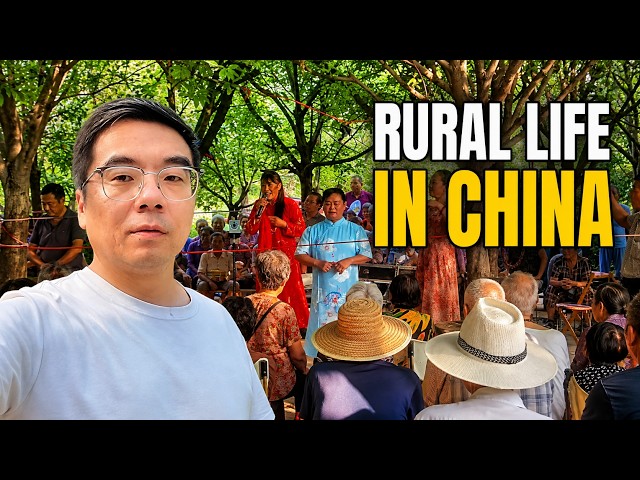
shipped straight here. Rural China has fully entered the e-commerce era. Because of urbanization, most of the young people have moved to cities. So, the village population is skewed older. But don't worry, the elders are living their best lives. Chinese checkers is the most popular pastime. A crowd always gathers to watch. >> Card games are huge, too. Especially among the grandmas. I genuinely don't know why. But they are really into poker. There's a senior activity center where people hang out, chat, and watch a traditional opera performance. And the
village temple sees regular visitors burning incense and praying. Keeping centuries-old traditions alive. People always ask me why I live in the village when I could be in the city. Honestly, it's the human connection. In the village, everyone knows everyone. You say hi to your neighbor on the street. No rushing, no awkward elevator silence. >> That kind of adventure on holiday connection is it something I've already felt in the city. And I think it's the most underrated thing about village life. The village has its own clinic and a barber shop. Got a
fever, a stomach ache, a cold? You handle it right here. Effective treatment, incredibly low cost. For most of daily needs, you never have to leave. Every village is a working to grow its local economy. And this one is no different. There's more factories operating within the village. So, residents can earn a steady income without having to move to a distant city. Work from village, basically. Even though every household technically owns land, very few people actually farm it themselves anymore. The most common approach is land leasing. Families rent out
their plots and collect an annual income. Some villagers do still farm, but they focus on high-value crops like orchards and greenhouse vegetables, operating at scale to make it worth it. With me. When night falls, the village's sports center comes alive. Kids run around and play. Young people shoot hoops and break a sweat. Middle-aged folks play ping pong or take a walk. It's the most relaxed, joyful hour of the day. The whole community are together, unwinding. Okay, I almost forgot to mention one of the most important things about rural China. How land
and housing actually work here, because it's a genuinely unlike anything most of people are used to. In China, rural land is collectively owned by the village. But here's the deal. Every family gets allocated a plot of a residential land, called a home site, and they can build their own house on it, completely free of a charge. Now, this is an important distinction to understand. You don't own the land outright. You hold a usage rights. But in practice, as long as your family continues to live there, those rights are yours indefinitely, passed down
through generations. It's about as secure as ownership gets. This also a really interesting policy for larger families. If a household has two or more sons, when those sons start their own families, they can apply to the village for a new plot of land and build their own separate homes. The results, almost every family in the village lives in their own standalone house. No mortgage, no rent. For a lot of our city dwellers drowning in housing costs, that's honestly the dream. This is what a Chinese village looks like in 2016. Not a poverty-stricken
stereotype, not some romanticized rural utopia either. Just a simple, warm, surprisingly modern life lived by real people. If you found it interesting, hit subscribe. I'll keep documenting places and people most of the travel content never shows you. See you in the next one.