Riding China’s Driverless High-Speed Train from Hohhot to Beijing
Video transcript
Do you want to see a train that will completely blow your mind? This is the groundbreaking Fushing Intelligent EMU, the world's first driverless high-speed train. I'll take this cuttingedge bullet train on a trip through rural China, showing you all the incredible technology packed into this striking bullet train. And that's not all, as I'll be traveling in a private business class suite. This is going to be one of my most extreme train journeys yet. So, join me as I head to Beijing. Hello and welcome to Huh Halt in the Inner Mongolia region of China.
Today, I'm stood outside of Hohhat East Highspeed Rail Station and I'm going to be catching one of China's many high-speed G- Trains. However, this isn't just any journey as I'm going to be traveling on board the selfdriving CR400B-C. This is going to be an incredible journey in the business class suites. Let's go. Good afternoon from Hohhat, a city in northern China with a population of 3 million. However, despite this size, the city is almost totally unknown in the west. It's part of the Inner Mongolia region and is even the provincial capital. The
region being one of the only places in the world to use the traditional Mongolian script. Just look at that. look at that. Outside the station, you can find the ticket office. This features a huge row of ticket machines with a screen showing any available seats. Trains in China sell out fast. There are also staffed ticket counters, though I recommend buying online for ease. The station is accessed on foot by this rather strange underpass. It was a very weird place with a lot of shouting for some reason. some reason. You can also arrive here by taxi or
take the hohort metro. The entrance to stations in China can be intimidating for the inexperienced traveler. Tickets are linked to your ID and foreigners have to head to the manual inspection lane to show their passport. Then an airport style security check. It's always worth getting here early just in case. As a major station, Hohort East has a large selection of food and drinks for sale. Even Western classics such as McDonald's and KFC make an appearance, also displaying their brands in the traditional Mongolian script, which I thought was pretty cool.
There are also many typical Chinese chains dotted throughout the station and perhaps most interestingly, the Russian import shop. A lot of people say that Chinese high-speed rail stations are very seamy and characterless, but I disagree. Hohhat East features a large dome inspired by the Mongolian nomadic G tents with many traditional patterns worked into the modern architecture. There's also a help point and a water refilling station. But the bad news is unfortunately the station's museum and moral model hall were not open today. As I'm traveling
business class, I get access to the lounge prior to departure. This is sort of tucked away in the corner, and it's not obvious that the station even has a lounge at first glance. Indeed, many stations in larger cities do not. cities do not. Hello Hello Not all lounges on the Chinese railway network are created equal, but this one was actually all right. There was plenty of choice of seating, some power sockets, and most importantly, the lounge provided a resppite from the booming announcements on the main concourse. There's a reasonable selection of
packaged snacks for such a small lounge with a range of drinks available, too. And here in the fridge, you can find the exact same drinks. Only the ones in here were cold. were cold. Okay, just finished in the business lounge here in Puhaong station. Wasn't anything too impressive, but it does the job for a few minutes. Anyway, let's head over to the train and find my business suite for the journey to Beijing. My train today is the 1446 to Beijing North, train number G2470. G is the highest category of train on the Chinese railway network, promising the
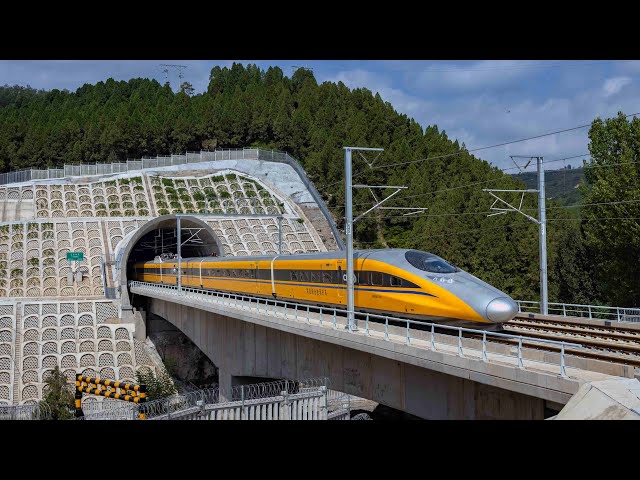
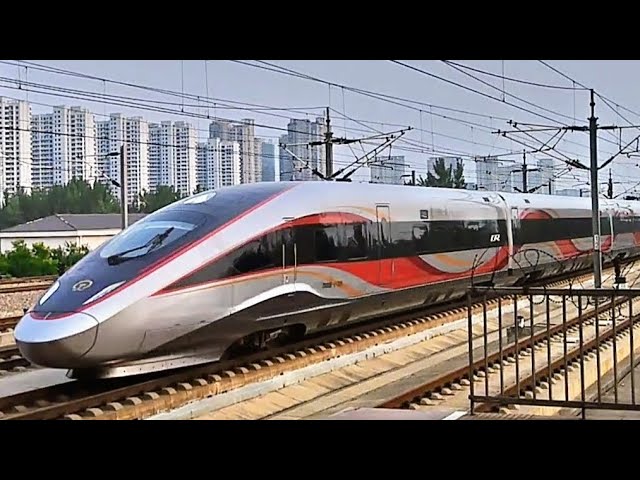
fastest journeys and great service on board. Safe to say I'm looking forward to seeing what today's trip will be like. Another ticket check is required to reach the platform. And as a business class passenger, I get to use the priority access lane. A good thing, too, as these cues can get very long. And here it is. China's incredible self-driving high-speed train. The CR400 BFC. BFC. This beautiful bullet train was built in 2020, coinciding with the launch of the Jing Jang Intercity Railway, the first driverless highspeed line in the world. It's adorned
in a special livery for the 2022 Winter Olympics. A striking design featuring flowing snowflakes and silhouettes of athletes. Let me know in the comments if you know of any other similar designs elsewhere in the world. I really love this livery. I'm traveling in coach 1 in the small six seat business class section tucked away by the rear cab. These seats are in a oneplus 1 layout with a staggered arrangement, meaning some seats are situated away from the window, but I've lucked out. My seat is 1F, one of the seats that is next to the window. Today's
route sees us heading east across Inner Mongolia to Jangja, where the train will then drive itself beneath the Great Wall of China all the way to Beijing. Journey time is scheduled to be 2 hours and 26 minutes, covering 459 km or about 285 mi. We depart 1 minute early at 1445. 1445. Right now, the train is under human control and will remain so for quite a while. Only the later Jang Jako to Beijing section of our route is fitted with driverless technology. There are two railways between Hort and Jang Jako. The classic line down below and the highspeed
line we're on now. While we'll reach Jang Jako in about an hour and a half, the classic line takes over 5 and 1/2 hours. Just goes to show how much of a game changer highspeed rail can be, especially for communities surrounded by mountains. So, let's start off with a look at my private business class suite. And believe me, there's a lot to dive into here. This suite resembles that you'll find on longhaul business class flights. It's like a little private room to yourself. yourself. There's a good amount of padding. It's not the softest seat out there,
but was very comfortable and had ergonomic shaping. There's also a padded head cushion which can be moved up and down to fit your height. Here is the seat's single proper armrest. Yes, that's right, just one. The other side only has a little flap folded away in here. Much like on airlines, the gimmick of a privacy door can be found in business class. This seems quite cool at first, but even with the door open, you can't see your fellow passengers, but anyone standing up can see in anyway. Let me know in the comments what you think. Is this door useless,
or am I just being too harsh? too harsh? These seats also come with a cushion you can place where you like to give better support or enhance comfort. Each of these business class suites have a side table ideal for keeping things within reach. There's an intricately detailed groove for placing a drink and even a wireless charging pad. The window sill serves as a shelf with enough room for a drink or your phone. Lastly, there's a workt that slides out from beside the seat. This was pretty wide and good enough for lighter laptops or phones and tablets using
this holder. Now, of course, the seat's main feature is its futuristic comfort control panel, but that'll have to wait for now as it's time for the onboard service. Each passenger in business class gets a complimentary snack box with different levels of quality depending on the regional division responsible for the service. service. The snack box contains some six items. I do wonder how much of this actually gets eaten. eaten. There's also a choice of drink. I went for a hot tea. Business class also includes a complimentary hot meal, but this is only
served at certain times. And I traveled outside these hours, so none was offered. offered. Outside, we're speeding through the Inner Mongolia region of China. This is one of the country's least densely populated regions with most of its population here in the southern part of the region away from the international border. Scenes like this are what truly help you to appreciate the transformational nature of high-speed lines as our cuttingedge bullet train speeds through mountains and across valleys. After a while, we slow down and enter another one of the
region's few urban areas. This is Olan Chab, a city of 1.7 million. While the station is in the city, it's a way south from the center. Our time in Ulanchab is brief and just a few minutes later we're back up to speed. Our current maximum speed is 250 km an hour which is pretty slow at least by Chinese standards and we'll be going much faster later on. But before we get there, let's go and have a look around the rest of the train. First and business class get access to a dedicated toilet located between the two classes. This toilet is a lot fancier than
the others found on this train. No, seriously, it's a completely different design. Everything was spotless with a posh bottle of soap provided and a stylish golden tap. First class is a major step down from business class, though it's still more than good enough, featuring spacious 2 plus2 recliners. Second class is in a 2 plus 3 layout. I'm not a fan of 2 plus 3 seating on trains. I can't imagine anyone is, but the seat comfort and leg room here is really great, and I'd have no problem spending longer journeys here to save money. This is the
multi-functional carriage featuring a buffet counter selling hot takeaway meals as well as drinks and snacks. Now, you might think this is a seating area for dining passengers, and you're sort of right. However, these seats can also be booked and reserved, and passengers will spend the entire journey here. And in line with this train's Winter Olympics theme, you'll find ski storage throughout the train. Jung Jako will be our next station where the train will start driving itself and we're rapidly closing in. But let's quickly take a look at the last few
amazing features in the business class suite. This is the seats media screen available only in business class. Here you can see journey progress, a live speedometer, and a map of the train. There are also a few videos about the train itself, though no actual movies or TV shows. There's also no Wi-Fi. Not really a problem as mobile signal in China is excellent even in the most barren areas. Up here is the seat's power socket compatible with different types of plug. of plug. There's also a USB socket. This seat can be adjusted on three axis and does
transform into a flatbed much like its airline counterparts. And it's a pretty decent place to lie down, too, with a reasonably sized foot cubby at the end. You're also able to adjust the lower leg support and customize the seat into the most comfortable position. most comfortable position. Another feature borrowed from the airlines is the individual air vent found above each suite. There's also electronically dimming windows, a high-tech feature, though, uh, I prefer the blind. It works better. Luckily, one feature they didn't take inspiration from was
belts on the seats. However, there were belts down here for some reason, and I'm not sure why. Tell me in the comments if you have any idea why this could be here. We're now entering the city of Jangja. Internationally, this is best known for partly hosting the 2022 Winter Olympics, but this is a railway channel, so for me, this is notable as the beginning of the self-driving section of Highspeed Line. And just like that, our train begins to drive itself towards Beijing. The Jing Chang Intercity Railway running from Beijing to Jang Jaor is the world's
first high-speed railway developed for driverless train technology. Most services use CR400 BFG or CR5 trains. However, these units require a driver, making our train a very special catch. Only three of them were ever built. Passing above is the new highspeed line from Chong Lee, a popular ski resort town. No doubt now even more popular as it's only 90 minutes away from Beijing by train. by train. We just left Jangjako, which now means that the train is driving itself. Absolutely incredible bit of technology for the remaining 1-hour ride into Beijing.
We're now speeding along at up to 300 km an hour, which is the maximum achieved on today's journey, despite the track and train being authorized for hire. This is the Guanting Reservoir built in the 1950s. It was originally a key source of water for Beijing, falling out of use in the 1990s. And this tunnel is the one that will carry us at speed under the Great Wall of China with the track to the platforms of the station being just about visible here. Believe me, this station is a long way underground. way underground. And as we're closing in on the
capital, let's talk about how much this trip costs. I think the price will surprise you. My oneway refundable business class ticket costs just 646 Chinese yuan. Clearly an unbelievable price for such a luxurious experience on a top rate high-speed train. We've made it to the massive Chinese capital city, Beijing, and slowly pull into Beijing North Station, one of the few true terminal stations on the Chinese railway network. Arrival is 4 minutes early at 1708. Overall, this was a faultless trip with China railways. These new Fushing trains are a
well-built and smooth ride, and the business class suite is a great product, not to mention the cuttingedge driverless technology that safely delivered us to Beijing. But this isn't the only cuttingedge high-speed train in the world, with the French TGV Duplex, also being known for its record-breaking speed and unique double-decker design. An incredible experience that you can see by clicking up here now.